EVERYBODY HAS TO START SOMEWHERE


The brilliant illustrator Bernie Fuchs is famous for his sleek, ultra-cool pictures that transformed the face of illustration in the 1950s - 1970s. The following details from an original illustration demonstrate one of his traits that I admire the most-- his ability to combine bold, innovative designs with rock solid traditional drawing skills.


The following detail is of Fuchs' close friend Austin Briggs, reflected in the window of an old car.


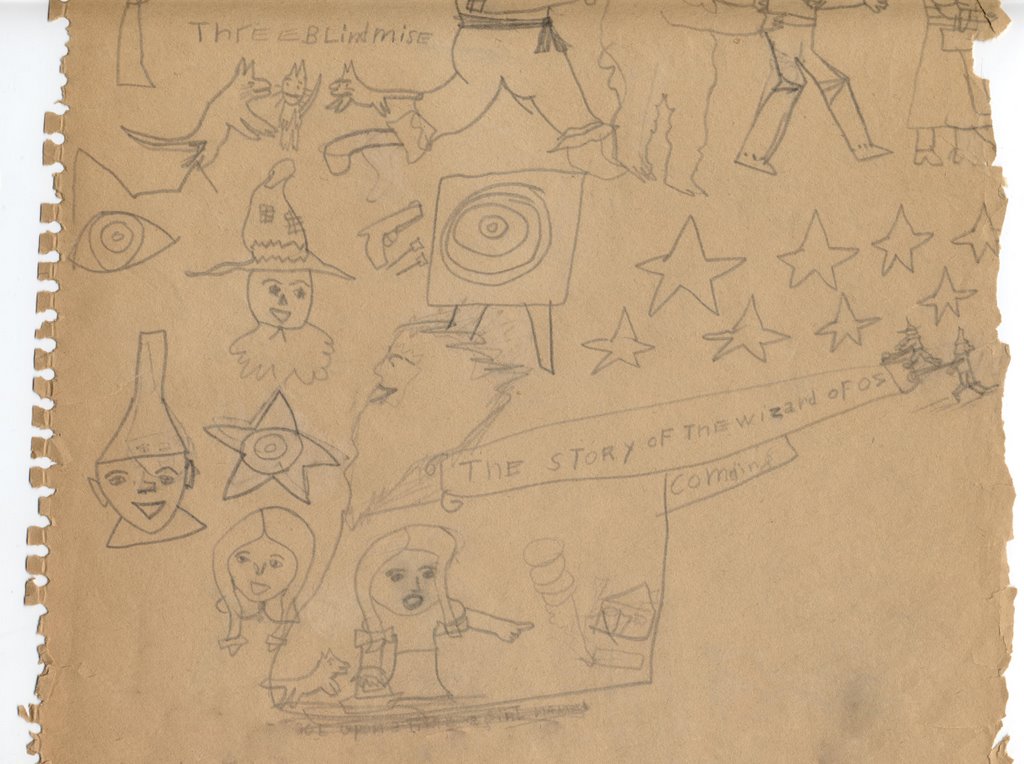
Nobody is born with this kind of facility, not even the great Bernie Fuchs. The proof is in Fuchs' childhood drawings which were carefully kept by his high school sweetheart-- now his wife.


Fuchs was seven years old when the movie The Wizard of Oz came out. It obviously made a big impression on him.


I like these childhood drawings, but at some point Fuchs went from drawing like lots of other kids to becoming the superstar illustrator of his generation. As Walt Reed wrote, "his pictures are probably more admired-- and more imitated-- than those of any other current illustrator." Fuchs is very modest about his accomplishments, but he is not afraid to talk about the importance of commitment in a young artist:

I was working in my grandfather's basement at night. I had set up a table there to do my art assignments. It was hard for me. I'll never forget throwing the paint,the brushes, the drawing board and everything across the basement floor and against the wall and crying-- literally. Finally I pulled myself back together, picked up the stuff and started over again.

And thus, a star was born.

THE ARTIST'S CONSOLATION


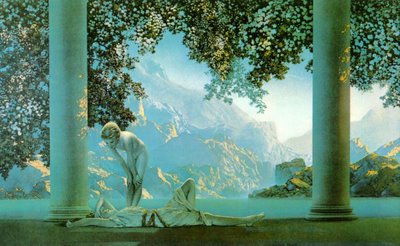
This illustration by Maxfield Parrish recently sold for $7.6 million, making somebody very wealthy. Parrish could've used some of that money toward the end of his career, when he fell out of favor with the public.

After Parrish died, two rival art dealers entered into a bitter tug of war over his artwork. The battle raged in angry lawsuits from coast to coast. (cf Cutler v. Gilbert) Each dealer claimed to be protecting the Parrish legacy as charges of fraud, counterfeiting, slander, libel and profiteering flew back and forth. Among the accusations traded in the Boston Globe:

One of the dealers was a "convicted swindler" who pleaded guilty to a felony.

One of the dealers was selling fake Parrishes to unsuspecting buyers

One of the dealers was reproducing Parrish's art without permission

One of the dealers defrauded a store owner by charging $10,000 for the right to call her store the "Parrish Connection" and use the artist's signature as its logo.

One of the dealers was trying to create a monopoly to control Parrish reproductions out of pure greed.

One of the dealers burned down Maxfield Parrish's house

Sometimes being a shrewd art dealer pays better than being a talented artist. One of these fine ladies lives in a mansion modeled partially after the palace at Versailles. The other ran several corporations (sometimes going under the pseudonym "La Contessa De La Gala"). Both were moved by the beauty of Parrish's art to fight over his copyrights like two scorpions in a bottle. Meanwhile Parrish slumbered peacefully beneath the soil.

It's hardly news that illustrators are commercially exploited. Art that never found its way back to the artist from the printer today sells for hundreds of thousands of dollars. A Rockwell just sold for $15.4 million. An N.C. Wyeth sold for $2 million.

Meanwhile, young illustrators face new kinds of adversity, as they struggle with clients who demand work "for spec," or find themselves competing with ready made stockhouse images. It's a difficult career. As Dan Pelavin wrote:

Illustration as a career is most successfully pursued by those to whom no other option is acceptable. It takes that kind of motivation to overcome the inevitable and constant stream of obstacles. Some frankness about the nature of the illustration market and the people an illustrator will have to work for would go a long way in discouraging all but the most foolhardy and desperate from pursuing this glamorous and enviable career.

So what's in it for the artist? What consolation can he or she take from this historically unfair process? I'm not sure, but I suspect the deal is that artists get to look out of their eyes onto a world like this:
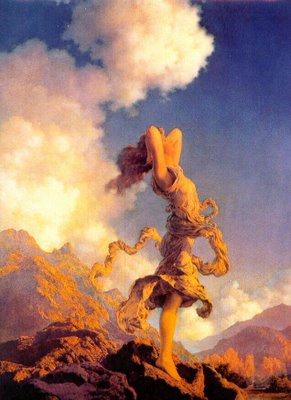


Perceiving the world the way an artist does may not help much when it comes to buying a house that looks like Versailles or even feeding your family, but it is not totally without its rewards. As Erica Jong wrote:
In a society in which everything is for sale, in which deals and auctions make the biggest news, doing it for love is the only remaining liberty. Do it for love and you cannot be censored. Do it for love and you cannot be stopped. Do it for love and the rich will envy no one more than you. In a world of tuxedos, the naked man is king. In a world of bookkeepers with spreadsheets, the one who gives it away without counting the cost is God.

A FEW SMART DRAWINGS

The illustrator Fred Ludekens said "drawing is thinking." Here are some wonderful examples of what makes visual thinking better than verbal thinking:


copyright The New Yorker

Images can convey complex thoughts with more immediacy, universality and ambiguity than words can offer.


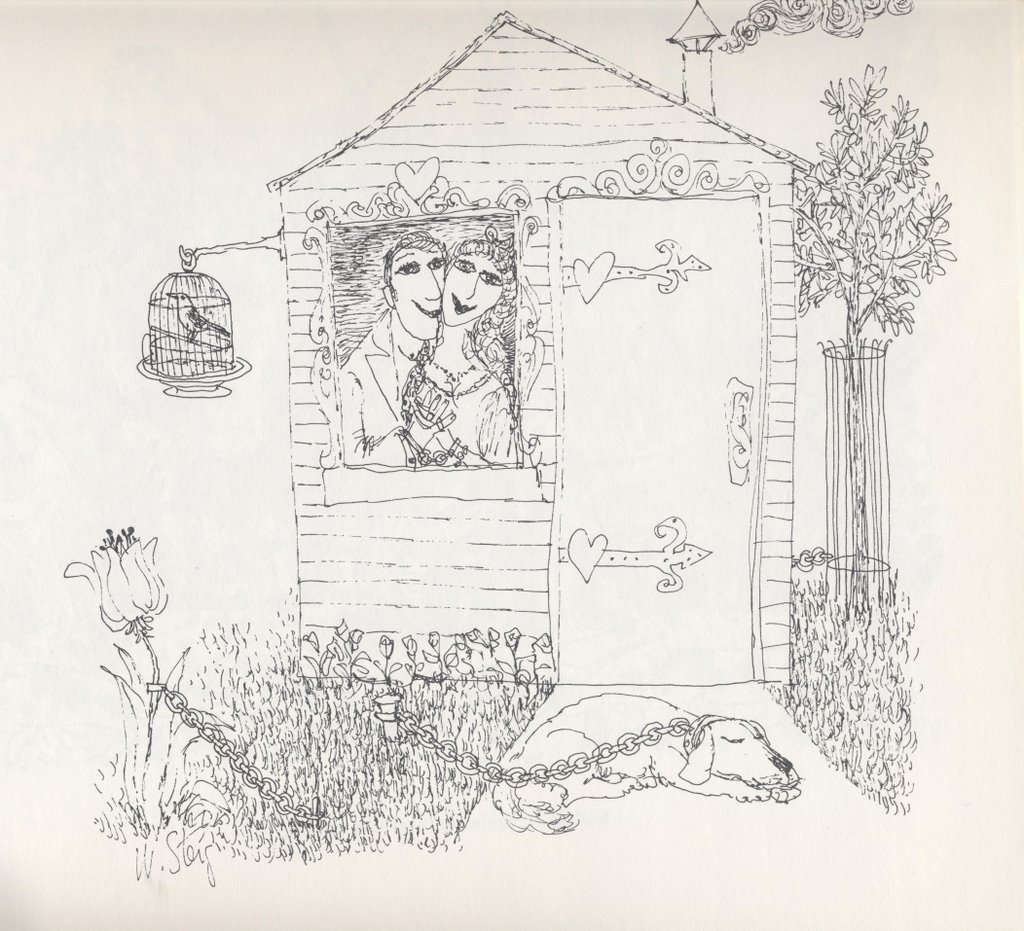
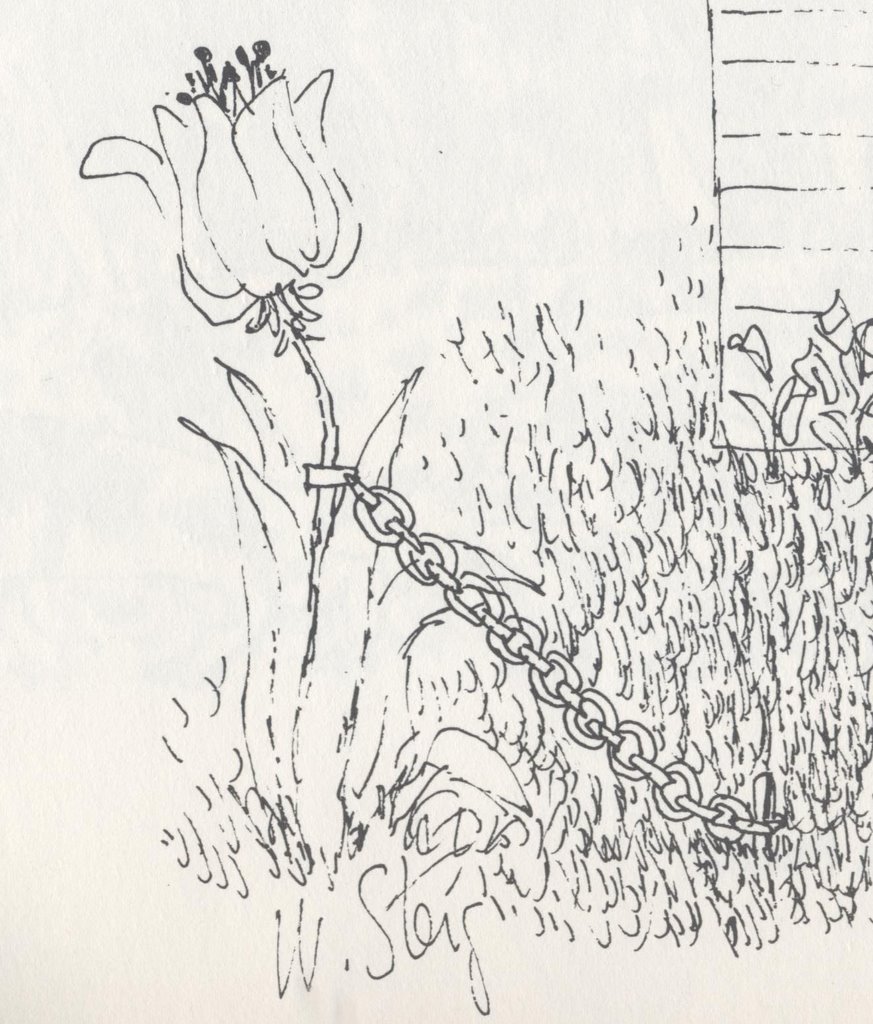
For example, William Steig's drawing above of the blissful young lovers in the cottage makes a wicked statement about the darker, proprietary side of bliss by chaining the flower in the front yard:


As another example, the Foote Cone & Belding drawing below shows that creativity and logic are two sides of the same phenomenon by placing them on opposite sides of a moebius strip-- which only has one side.


copyright Foote, Cone & Belding

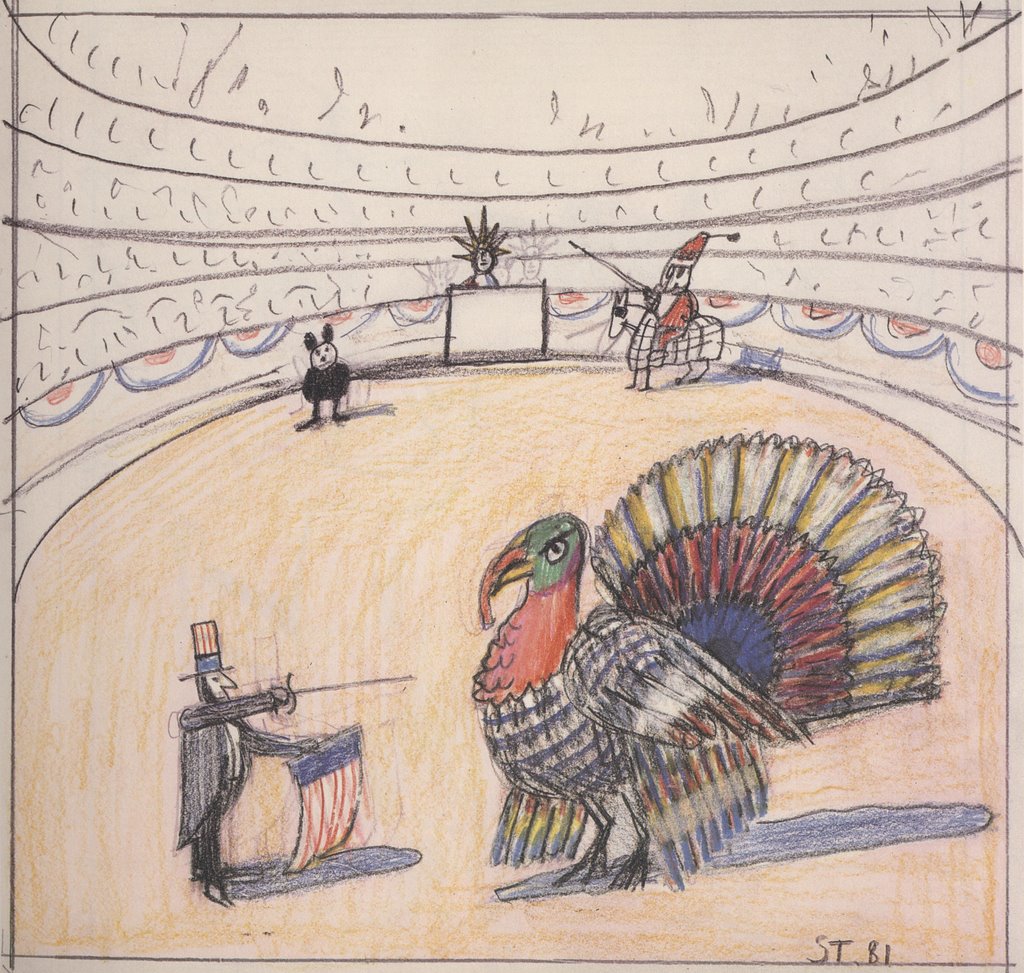
Next, the symbols chosen by the brilliant Saul Steinberg-- Uncle Sam facing off against a fatted Thanksgiving turkey in the bull ring, presided over by the statue of liberty and Santa Claus-- juxtapose categories rich with meaning in ways that words with definitions just can't.


copyright The Saul Steinberg Foundation/Artists Rights Society (ARS), NY

How many sentences would it take to explain such thoughts in words? Good visual ideas dance where words cannot go. More importantly, how many related ideas would you miss along the way if you were led to a conclusion by linear sentences, rather than by rolling these images around in your mind?

Some sequential artists and graphic novelists seem to think that intelligent drawings are merely drawings accompanied by word balloons containing intelligent words. For me, this view surrenders the real strength and potency of the visual medium.

ARTISTS IN LOVE, part six


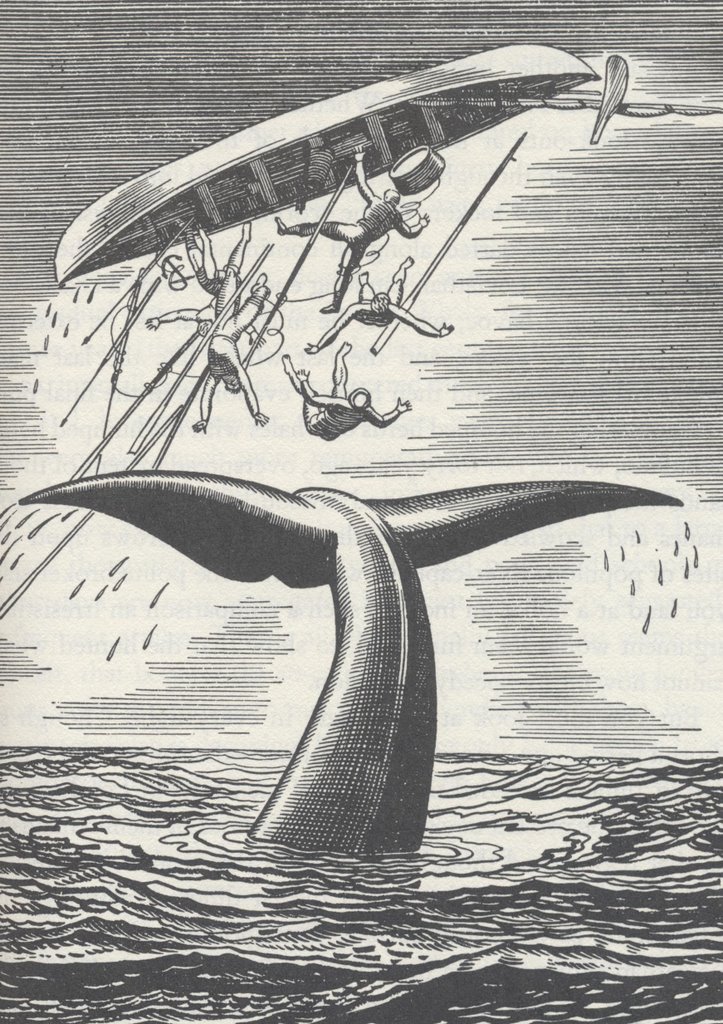
The illustrator Rockwell Kent (1882 - 1971) loved humanity with great passion. Unfortunately, he was an utter jerk when it came to loving individual human beings.

Kent was famous for his illustrations for Moby Dick, Candide, Shakespeare and Chaucer. He was also the author of several acclaimed books, an explorer, an architect, a dairy farmer, a carpenter, a fisherman, a sailor and an outspoken advocate of socialism who was awarded the Lenin Peace Prize by the Soviet Union for his work to achieve peace and brotherhood.


Kent had many wild adventures around the world. He hiked through jungles and over mountains. He explored islands and traveled on freighter ships. Once he attempted to sail around Cape Horn (at the southern tip of South America) in a ramshackle life boat that he bought for a few dollars. Wrote one commentator:


This region, boasting probably the world's worst climate, is buffeted incessantly by winds, swiftly alternating with rain, hail and snow. It is the legendary graveyard of ships and sailors, and Kent [had] the half-formed idea of trying his mettle against the hazardous adventure of sailing "round the Horn."
He was shipwrecked in Greenland and Alaska and lived for extended periods of time north of the Arctic Circle in desolate places like Ubekendt Ejland (Unknown Island). But his first love was painting and he painted almost every day.


Kent's artistic mentor was the painter Abbott Thayer. While living as a guest in Thayer's house, Kent married Thayer's 17 year old niece over the objection of her family. Four months after the wedding, he resumed a love affair with an old flame. Kent went on to have torrid affairs with a variety of girlfriends while his devoted wife stayed at home and bore him five children. (When one of his girlfriends became pregnant, Kent and his wife had to sell everything they owned to pay her off.) When his fifth child was born, Kent decided that his wife's clinging ways were unbearable, so the couple divorced. Kent learned from this experience and made sure all of his future children were illegitimate. Kent's second wife, Frances, may have hoped Kent was willing to settle down because he built a dream house with her out in the country and named it "Asgaard" after the Norse home of the gods. But at the housewarming party that Kent and Frances held for their friends, Kent overheard someone planning a dangerous boat expedition to Greenland and immediately abandoned Frances and Asgaard for this new adventure. Kent did marry a third time, to a woman the age of his youngest daughter.

Kent courted these women using artwork and poetry, and he praised their beauty with great eloquence. He always felt bad (and a little surprised) when they took the news of his infidelity so hard. One former showgirl committed suicide, jumping to her death into the sea. Perhaps it would have been difficult for a wife to accompany Kent on his rugged travels. Kent recounted one particularly horrifying shipwreck in his autobiography, It's Me O Lord:


Against the hurricane that woke us, sweeping down off the lofty plateau of the inland ice... we could do nothing but... hang onto our anchor ropes. And once the anchors failed to hold, the game was up.
Kent's tiny boat capsized. He and his two companions dragged themselves to shore and trekked 36 hours over rugged terrain with no shelter before they stumbled across an Inuit fisherman. None of them spoke Inuit, yet Kent managed to negotiate food, shelter and a young Inuit native girl.


Even though Kent had no space for a wife on his journeys, he always managed to find room for his paints, brushes and canvases. Following the shipwreck mentioned above, Kent returned to salvage his art supplies and spent two months painting that "vast wonderland of sea and mountain."


I have long been fascinated by the selfishness of artists. Some artists place the demands of their art above the welfare of their family and friends. Sometimes the resulting art is so beautiful, the trade off seems worth it to those of us who aren't personally affected. But it is always difficult to draw a bright line between artists who make sacrifices to protect their art and those who are merely self centered. Through the generations, a lot of collateral damage has been caused by artists fighting for their artistic lives.

Kent lived to be 89. Despite all his advetures, he seemed to have had a wistful old age. In one of his books, he described a poem-song he had learned from the Eskimoes about an old man who remembers

old times when I had strength to cut and flay great beasts.


Three great beasts could I cut up while the sun slowly went his way across the sky.

A sick old man could no longer hope to hang onto a woman, so he wishes his

woman away in the house of another,


in the house of a man who may be her refuge, firm and sure as the strong winter ice.


Sad at heart, I wish her away in the house of a stronger protector now that I myself lack strength even to rise from where I lie.


RONALD SEARLE


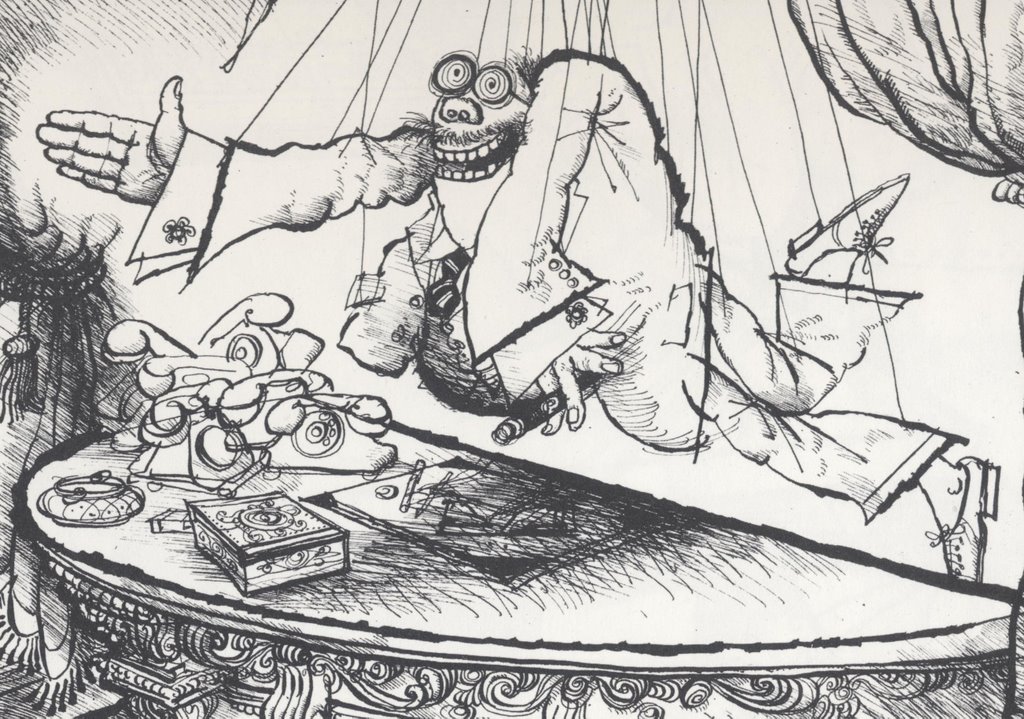
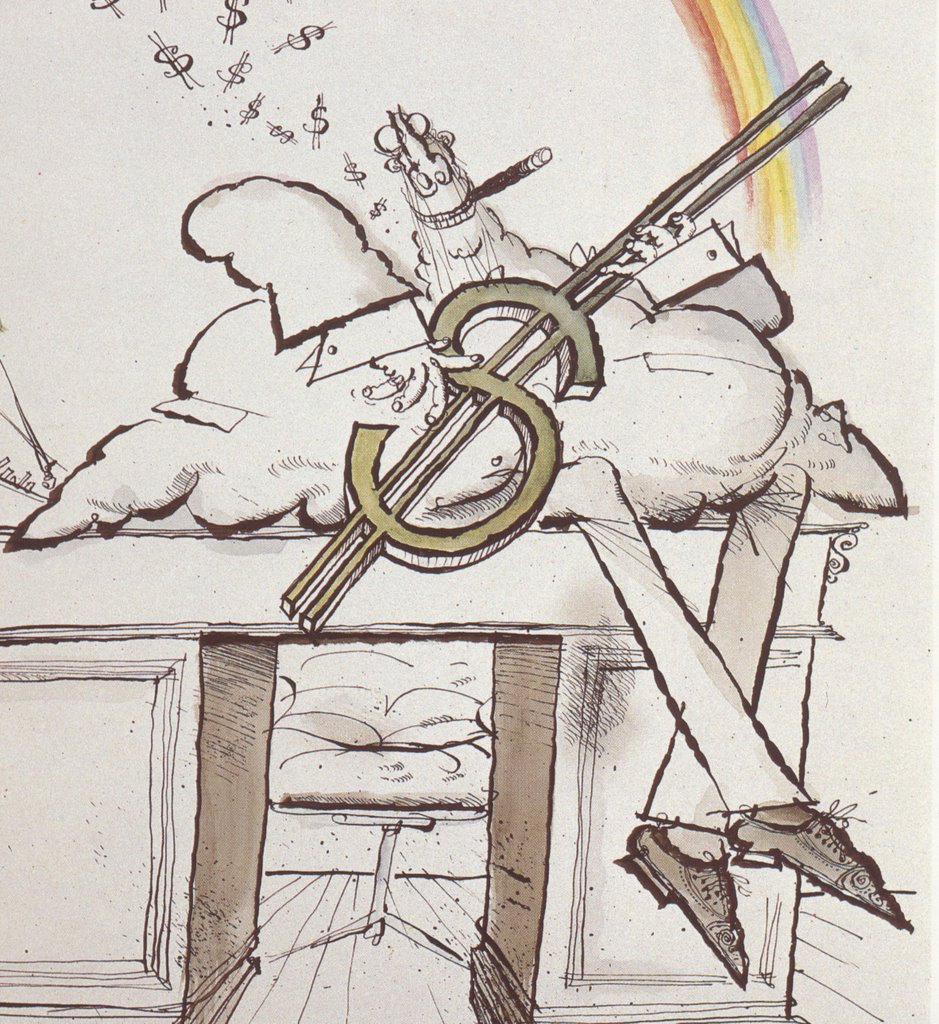
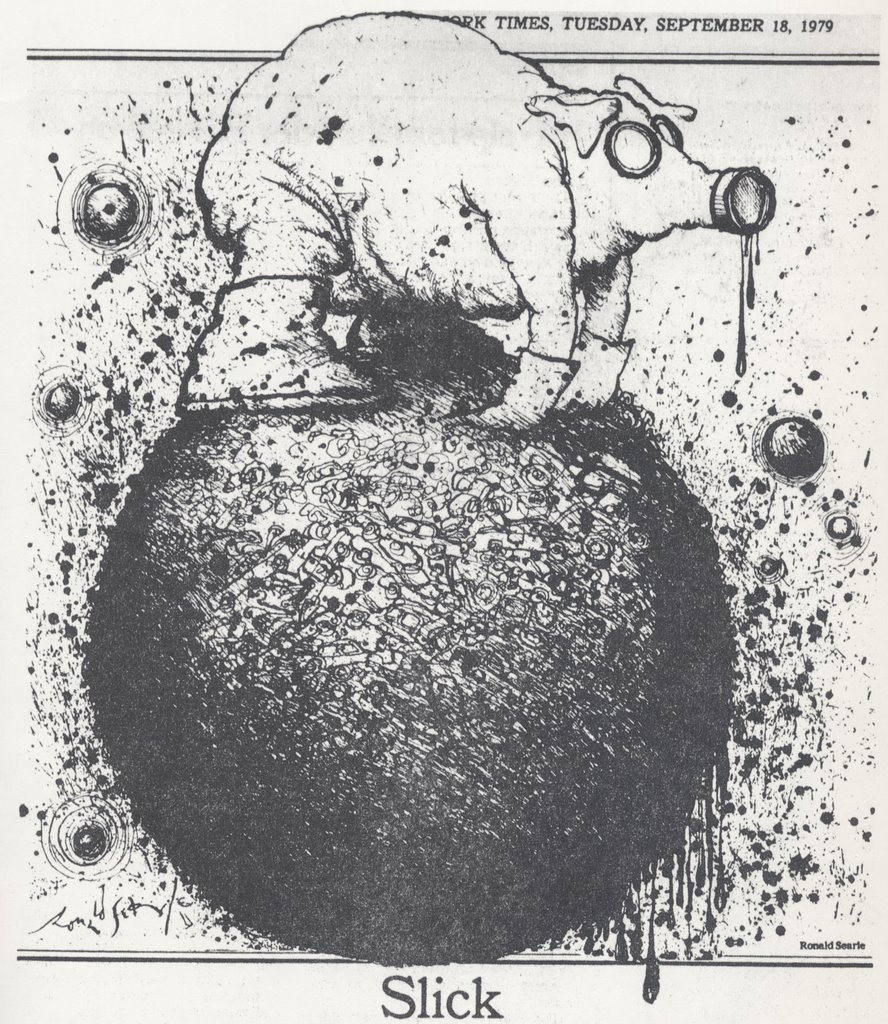
Here are the 5 things I love most about the work of the great Ronald Searle (1920 - ).


1.) He is absolutely fearless with ink: the bite and splatter of his drawing remind you how people used to draw before software was invented.


Searle makes a serious commitment with ink, one that requires not only skill but courage. His drawings have the potential to go horribly awry if Searle ends up an inch to the left or right of his goal.

2.) Searle is able to step back from familar shapes and reinvent them: It is very hard to unlearn our basic assumptions about anatomy. Most artists who try end up merely exagggerating. But look at how Searle reinvents the human form. Think it's easy? Try it yourself. Or ask Picasso.


3.) Searle draws with great visual intelligence. You can tell from his artistic solutions that there is a radiant mind at work here.


4.) Even as an old man, Searle's work is playful and humorous (with all the subversiveness that implies).


5.) Finally, I like the path Searle followed. If I drew as badly as Searle did when he started out as an illustrator, I would have given up and gone in search of honest work.


Yet, Searle persevered and became one of the most influential illustrators of the second half of the 20th century. You can see his strong influence on Mort Drucker, Pat Oliphant and a whole generation of pen and ink artists who followed him. What happened to transform Searle's work? Was he hit by a lightning bolt? Did he have a mystic vision in the night? No one can say for sure, but I suspect part of the answer lies in the following quote:
At the Cambridge art school it was drummed into us that we should not eat, drink or sleep without a sketchbook in the hand. Consequently the habit of looking and drawing became as natural as breathing.
Searle never stopped drawing, and over the years his powerful style gradually emerged, as natural and organic as breathing.

WORDS AND PICTURES

[No pictures today-- I am writing from Beijing, China, far away from my art collection, my scanner and my sweetheart (hi, Nell!). But I'll be home in a few days, when I can update my blog with fewer words and lots of good pictures.]

My feeble attempts to analyze pictures using words reminds me of Flaubert's lament:
Human language is like a cracked kettle on which we beat out tunes for bears to dance to, when all the time we are longing to move the stars to pity.
Don't get me wrong-- I'm a big fan of words. They have a tough job: to tame a wild, omnidimensional universe of feelings, thoughts and sensory impressions into a straight line with punctuation and spelling. All I'm saying is that pictures manage to take me a few inches closer to Flaubert's stars than words do.

Beethoven said, "music is a higher form of revelation than philosophy," and listening to Beethoven's Piano Concerto No. 5, we surely believe him. Music is able to achieve that exalted height in part by leaving behind the limitations of words, just as the abstract part of art-- the shapes and colors and design-- leaves words behind. It is as close to music as the visual arts can come.

Call me sentimental, but I prefer illustration to abstract art precisely because illustration combines abstract visual design with those limiting, confining words that provide the content. Some people see the words part as an anchor. I see it as ballast.

AN ARTIST

A few days ago I posted a segment on Stanley Meltzoff's paintings of ancient Greece. I always wanted to meet the artist behind those glorious paintings, but now I never will. As I was posting my blog, Mr. Meltzoff was lying ill in a hospital. Today he passed away.


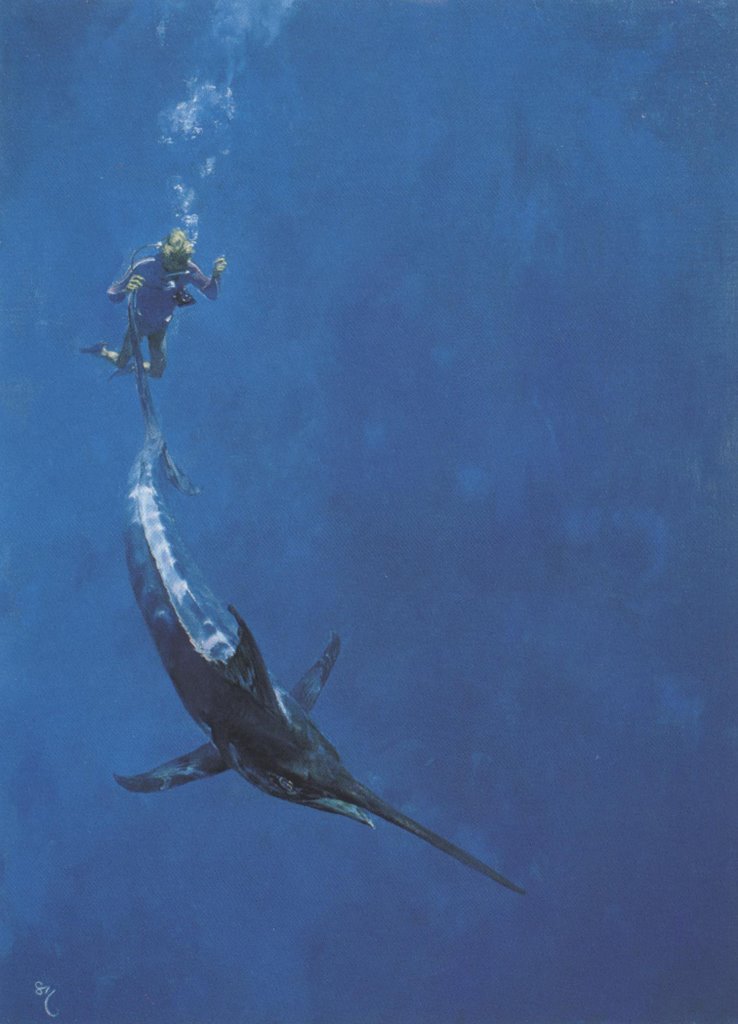
Diver's farewell to Blue Marlin by Stanley Meltzoff


Meltzoff was a gifted author, teacher and artist who painted images from science for Scientific American, historical illustrations for National Geographic and Life, and science fiction covers for a host of publishers.

Like thousands of others, I was enriched by his beautiful work. But I was most inspired by his astonishing intellectual curiosity and his deep artistic purpose. Meltzoff wrote about surviving in the years when the bottom dropped out of the illustration market:
My wife was ill, my children needed college money and I was almost 60 years old. I stood on the corner of 56th and Lexington Avenue in the rain with a soggy portfolio in my hands and improvised a sad little song about defeat, flat feet and flat broke while I tried to think of something to do.
Meltzoff responded to adversity with great artistic potency. He single handedly created a new market for paintings of seascapes and gamefish, which enabled him to combine his expertise in diving with his passion for art. In his spare time he compiled an art reliquarium and wrote a major scholarly treatise, Botticelli, Signorelli and Savanorola, Theologica Poetica from Boccacio to Poliziano. The book is a marvelous work of history, written with great lucidity, insight and humor-- the kind of epic accomplishment that would have capped an entire career for most historians. I recommend it to you.

Please join me in sending thoughts and prayers to Mr. Meltzoff's family. Irene Gallo of the Art Department blog tells me that we can look forward to a book about Meltzoff from publisher Donald Grant books. I will be first in line.

Most people who gamble on earning a living from their creativity have those moments of standing in the rain with a soggy portfolio. William Hazlitt wrote that, "In the end, all that is worth remembering of life is the poetry of it." Whatever else happened in his life, Mr. Meltzoff's gamble paid off royally. One only has to look at his art to know that his life was rich with poetry.